
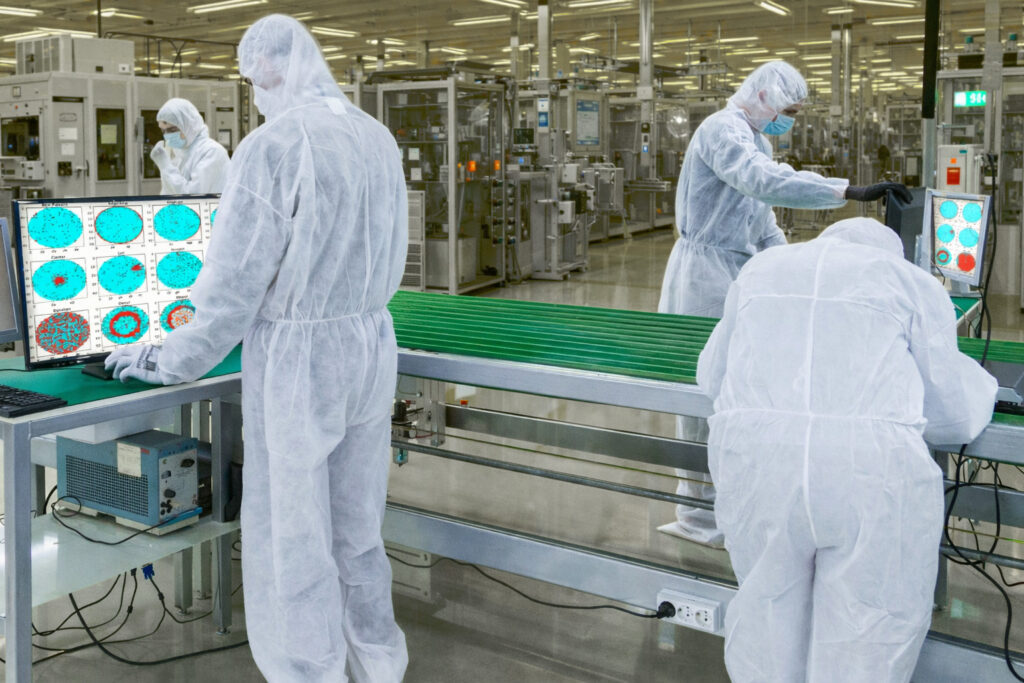
Semiconductor manufacturing is one of the most complex process optimization problems in the world.
Thousands of tightly coupled process steps, extremely narrow control windows, sparse and delayed metrology, and nonlinear interactions across the flow—yet critical decisions still rely heavily on manual analysis across fragmented tools and data.
The industry has made significant investments in AI/ML and digital twins, but a fundamental bottleneck remains:
the path from fab data to production-grade process optimization is still too slow, too fragmented, and too bespoke.
Fabs generate tremendous volumes of data, but when an engineer needs to investigate a specific issue for a specific product, toolset, process step, or node, finding the right data can become a needle-in-a-haystack problem. Teams often spend substantial time just identifying, querying, contextualizing, and preparing the relevant data before analysis can even begin.
And the challenge does not stop at data access. Building a new solution typically requires a long chain of work: data extraction, preprocessing, workflow construction, model development, validation with end users, and production deployment. In practice, that cycle takes 3-6 months. By the time a solution is live, product mixes may have shifted, new nodes may have entered, or process conditions may have changed enough to require a different variation of the same analysis.
As a result, many process optimization AI solutions remain short-lived and difficult to reuse. Data science and AI teams are forced to repeatedly build one-off workflows for problems, overwhelming specialized teams and limiting the reach of advanced analytics inside the fab.
What the industry needs is not just better models. It needs a reusable way to operationalize semiconductor knowledge itself—through configurable building blocks, master workflows, and interfaces that allow both expert teams and process engineers to generate fit-for-purpose variations of proven solutions at scale.
From One-Off Solutions to Reusable Primitives
Most semiconductor organizations today operate in a request-driven model, where process engineers surface specific needs—investigating a yield issue, analyzing a tool excursion, evaluating a new process window—and AI or data science teams respond by developing targeted workflows for those use cases.
This approach is both necessary and effective in the short term. It allows teams to move quickly on high-value problems and tailor solutions to the nuances of each situation.
However, over time, this leads to a natural pattern:
- Workflows are built to solve specific requests
- Implementations are optimized for local context
- Similar problems are solved independently across teams and time
The focus remains on delivering outcomes for the immediate need, rather than building reusable foundations that can generalize across future variations.
This is not a limitation of the teams—it is a consequence of the complexity and variability inherent in semiconductor manufacturing.
But as the number of use cases grows and product mixes continue to evolve, this model becomes increasingly difficult to scale. New variations of similar problems require new implementations, and even small changes in context can necessitate reworking large portions of an existing solution.
What becomes clear is the need for a transformative approach:
Not replacing bespoke solutions but augmenting them with reusable primitives that capture common patterns across workflows.
By decomposing solutions into modular building blocks—data connectors, preprocessing steps, modeling components, and analysis layers—it becomes possible to retain flexibility for unique scenarios while still building on a shared foundation.
This enables data science & AI teams to adapt to new products, nodes, and conditions without starting from scratch. More importantly, this approach creates the basis for a higher-level abstraction—master workflows—that encode how a class of semiconductor problems is solved, while allowing for variation to scale across different product mixes and process conditions.
How Reusability is Scaled at Fab-Level by the Multiscale Agentic AI Platform
Scaling comes from enabling engineers to adapt and apply existing master workflows continuously across changing contexts—new products, new nodes, new process conditions.
At Multiscale, this is enabled through our enterprise-grade platform for building and managing master workflows and digital twins.
The Multiscale platform serves as the underlying enterprise system where workflows are built, validated, and deployed. It is designed to handle the full lifecycle of a solution—from data ingestion and preprocessing to model execution and production deployment—within a unified environment. This allows solutions to move from prototyping to production within a single software stack, and ensures they remain operational as data and process conditions evolve.
On top of this foundation, Multiscale introduces a complementary layer—the Multiscale Agentic AI platform—that makes leveraging the scale of master workflows effortless for users.
Multiscale Agentic AI sits on top of the platform as a chat-based interface, allowing users to engage with platform capabilities through natural language rather than predefined workflows or rigid UI constructs. The two operate together as a single system: the platform provides the underlying execution and structure, while the AI interface becomes the entry point for intent.
Through this interface, users can describe the analysis they need—whether it is investigating a yield excursion for a specific product, adapting an existing workflow to a new node, or generating a different view of process behavior.
These requests are not treated as isolated queries. They are interpreted within the full context of the platform—its data pipelines, available modeling approaches, existing solution portfolio, and master workflows.
AI agents act on behalf of the user within this environment. Because they are grounded in how workflows are constructed and deployed on the platform, they can translate high-level intent into concrete execution—assembling or modifying the appropriate sequence of data processing, modeling, and analysis steps required for the task.
In effect, the interaction shifts from selecting and configuring tools to describing the outcome, with the system responsible for constructing the path to get there.
With this new paradigm enabled by Multiscale AI, building and deploying AI/ML and digital twin solutions for semiconductor processes can achieve a level of scale that was previously difficult to realize.
Data science teams are no longer constrained by the need to repeatedly address variations of the same problem. Instead, they can focus on what they do best—expanding solution portfolios into new process regimes, developing more advanced modeling approaches, and refining methodologies that drive deeper impact. The platform becomes the mechanism to scale the expertise of AI and data science teams, rather than requiring the teams to do the scaling manually to each new problem.
This shift extends beyond individual teams to the organization as a whole. As workflows are adapted and deployed more rapidly across a high-mix manufacturing environment, process optimization becomes more continuous and pervasive. The result is faster operationalization of new solutions, improved yield outcomes, and shorter yield ramp timelines—delivering measurable impact at the fab level.